
The Light That Holds Everything: Why Lighting Matters Most in Warm Minimalism
The Quiet Power of Light
Think about the last time you walked into a room and immediately felt your shoulders drop.
Not because of what was in the room — not the furniture, not the color on the walls, not even the tidiness of the space. Something else did it. Something you couldn’t quite name.
Chances are, it was the light.
Now think about the opposite: stepping into a room flooded by a single harsh overhead bulb, the kind that flattens everything into pale, shadowless sameness. The kind that makes a perfectly lovely space feel clinical. Cold. Like somewhere you want to move through quickly rather than linger in.
Light does that. It is quietly, constantly shaping how we feel in every room we inhabit — and most of us never stop to notice it until something goes wrong.
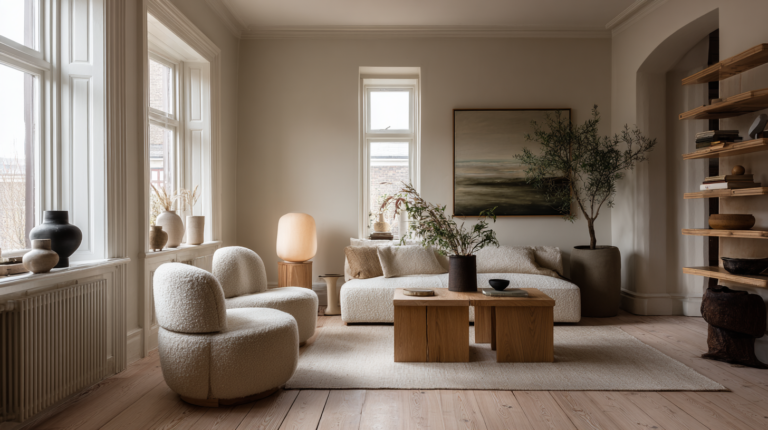
In this series, we’ve talked about space and how it breathes, and texture and how it speaks. But light? Light is what brings both of those to life. Without it, the most thoughtfully curated room can feel empty or harsh. With it, even the simplest space becomes warm, dimensional, soulful.
That is the heart of warm minimalism. Not fewer things for the sake of emptiness, but fewer things so that what remains — including the quality of light itself — can be fully felt.
In warm minimalism, lighting is never an afterthought. It is the gentle, invisible architecture of the room. It is what turns simplicity from cold and bare into something alive and deeply comforting.
This is an invitation to see your home differently. Not to renovate or spend extravagantly, but to look at the light you’re already living in — and ask whether it is truly serving you.
How Light Affects Us
Long before we understood it scientifically, we knew instinctively that light changed how we felt.
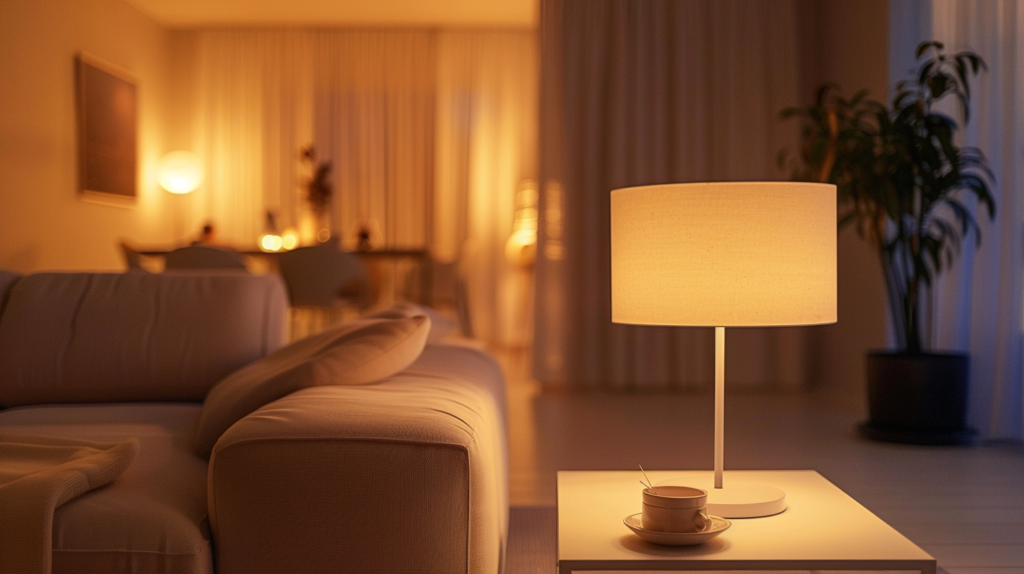
Our bodies are designed to respond to light in profound ways. Bright, blue-spectrum light signals wakefulness — it tells the brain it’s midday, time to be alert and active. Warm, dim, amber light signals something different entirely: safety, rest, the closing of the day. It’s the light of firelight and candles, of sunsets and bedside lamps. It tells the nervous system it’s okay to exhale.
This isn’t poetic imagination. It’s biology. Light directly influences melatonin production, cortisol levels, and our circadian rhythm — the internal clock that governs our sleep, our energy, and our emotional regulation. Expose yourself to harsh, cold light all evening and your body doesn’t know whether it’s noon or midnight. Bathe a room in soft, warm layers and you send a completely different message: you’re safe here. You can rest.
And yet, walk into the average minimalist home — the kind with clean white walls, spare furniture, and a confident design sensibility — and what do you often find overhead? A single recessed light, or a flat panel fixture, bathing everything in 5000K cool white light. Bright. Efficient. Shadowless.
It is, unfortunately, the visual equivalent of a fluorescent office.
This is why so many minimalist spaces photograph beautifully but don’t quite feel beautiful to live in. The design is right. The light is wrong.
Warm minimalism approaches light not merely as a utility — not just as something to see by — but as nourishment. The same way we think carefully about what we eat or how we move, we can think carefully about the quality of light we steep ourselves in each day.
Because light is something we absorb. It shapes our mood before we’re even conscious of it.
When the light in your home is warm and layered, something subtle but significant happens: you feel more at ease, more present, more like yourself. The space supports you rather than simply containing you.
And that, gently put, is the whole point.
The Three Layers of Warm Minimalism Lighting
Here is the single most important shift in thinking about light: stop imagining it as one thing coming from one place.
Light, in a living space, is a composition. And like any good composition, it has layers.
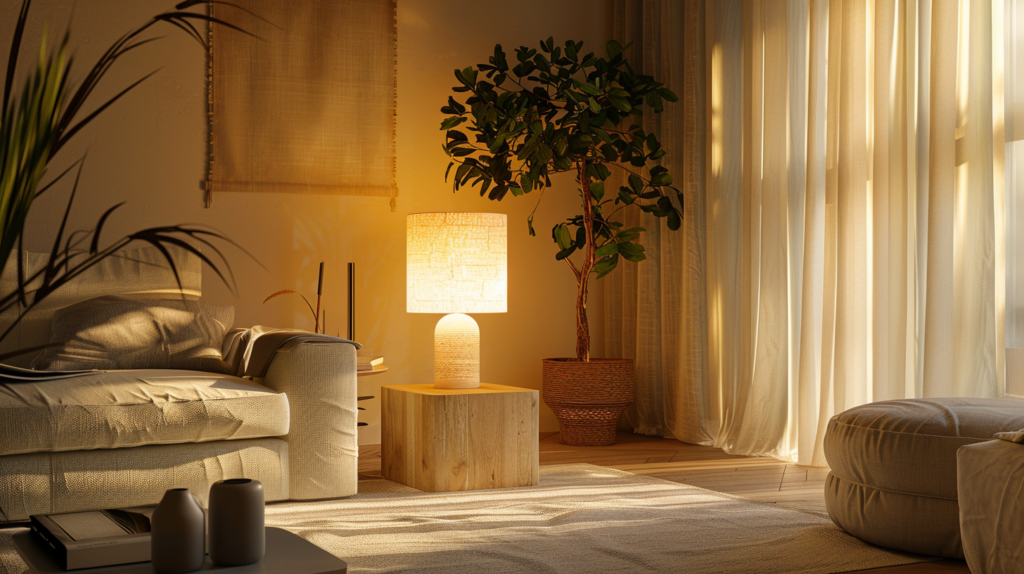
The first layer is ambient light — the soft, overall glow that gives a room its foundational mood. This is your dimmable overhead, your large floor lamp in the corner, your pendant light on its lowest setting. It should feel like early evening light: present enough to move comfortably through the space, but never so bright that it overwhelms. Think of ambient light as the room’s breathing — steady, quiet, always there.
In warm minimalism, ambient light should never be the only light. When it is, the room feels flat and institutional, no matter how beautiful the furniture beneath it. Ambient light needs company.
The second layer is task light — gentle, purposeful, directed. The lamp on your reading table. A small light at your desk. A soft pendant above the kitchen counter where you chop vegetables in the evening. Task lighting is intimate by nature. It creates small circles of focus, pools of warmth that say this is where something meaningful happens.
What task lighting should not be: harsh, blazing, or cold. Even functional light can be beautiful. A good reading lamp with a warm bulb and a linen shade isn’t just useful — it becomes a small still life in the room.
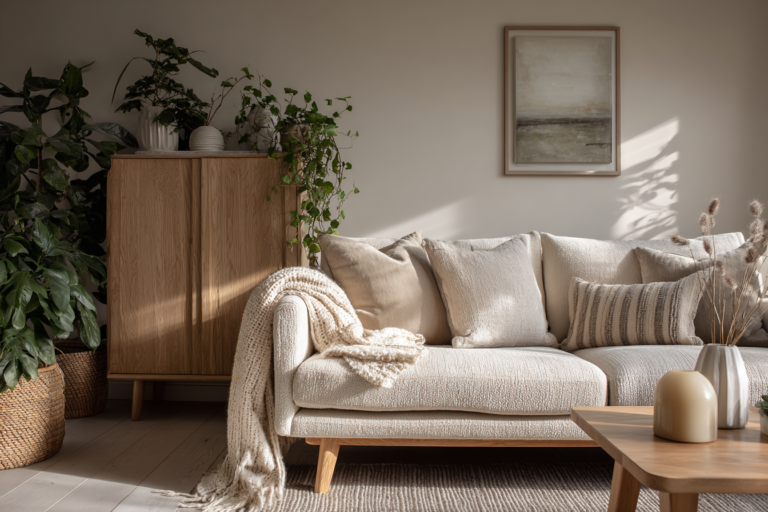
The third layer is accent light — the one most people skip entirely, and the one that makes the most emotional difference. Accent lighting is mood. It’s the small lamp tucked behind a plant that makes the leaves glow translucent green. It’s the candle on the shelf that throws dancing light against a textured wall. It’s a low-wattage Edison bulb inside an open cabinet, casting the softest halo on the objects inside.
Accent light doesn’t illuminate anything, exactly. It suggests. It creates depth, shadow, and visual intrigue. It reminds a room that it is three-dimensional.
When these three layers work together — ambient, task, and accent — something quietly extraordinary happens. The room stops feeling like a room and starts feeling like an experience. Your eye moves naturally. Shadows appear and soften the edges. Warmth pools in the corners. The space breathes.
This is layered lighting. And once you experience it, single-source overhead light will feel like something you can never go back to.
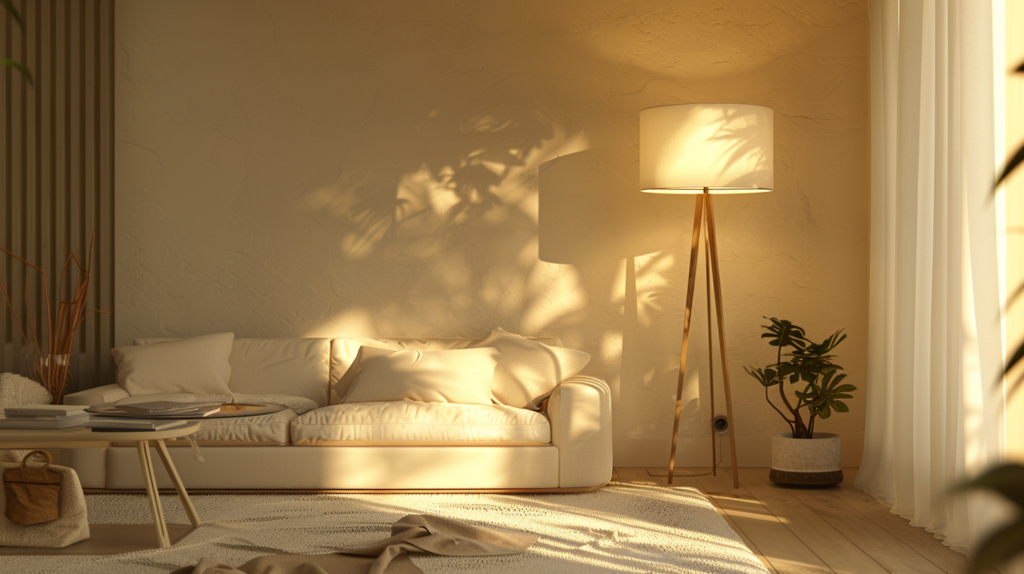
Natural Light: The Most Important Source
Before any lamp or fixture, there is the sun.
Natural light is irreplaceable — not just practically, but emotionally. We are creatures of daylight. We evolved beneath it, calibrated to it, and we miss it deeply when it’s gone. One of the most nourishing things you can do inside a home is learn to work with daylight rather than against it.
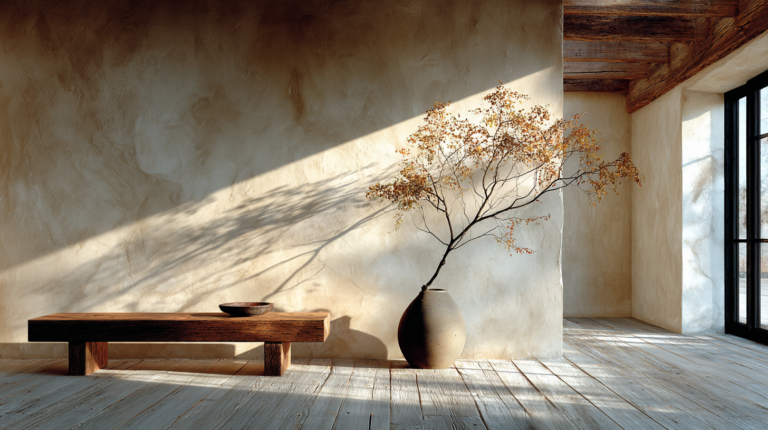
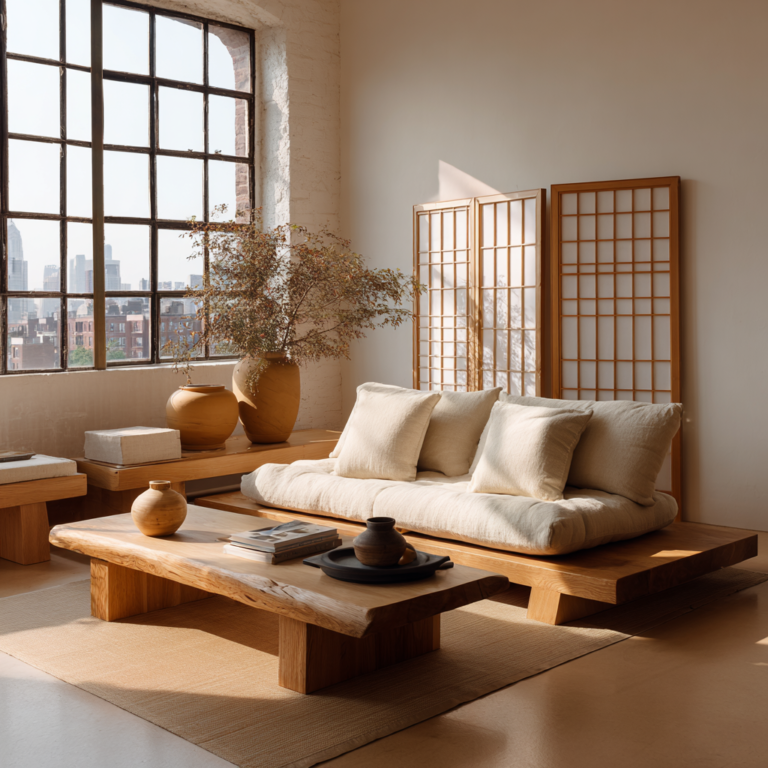
This begins with knowing your windows. Which direction do they face? A north-facing room receives soft, even, indirect light all day — cool and consistent, beautiful for concentration. A south-facing room floods with warmth for hours. East light is the tender, pale gold of morning. West light is afternoon glory — that long, honey-colored warmth that turns everything it touches into something cinematic.
Understanding your windows means you can arrange your life around them. A reading chair pulled close to an east window. A kitchen table in the path of the afternoon light. A moment in the west-facing room each evening just as the sun descends.
Are you letting the light in?
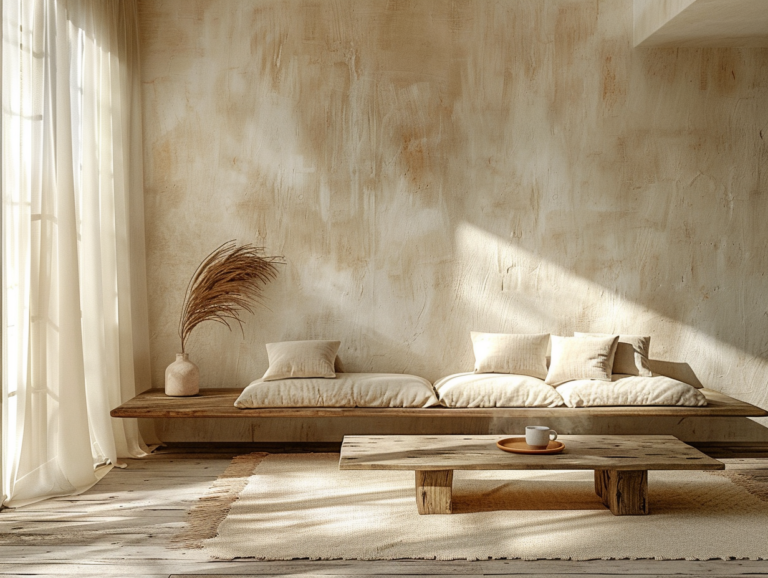
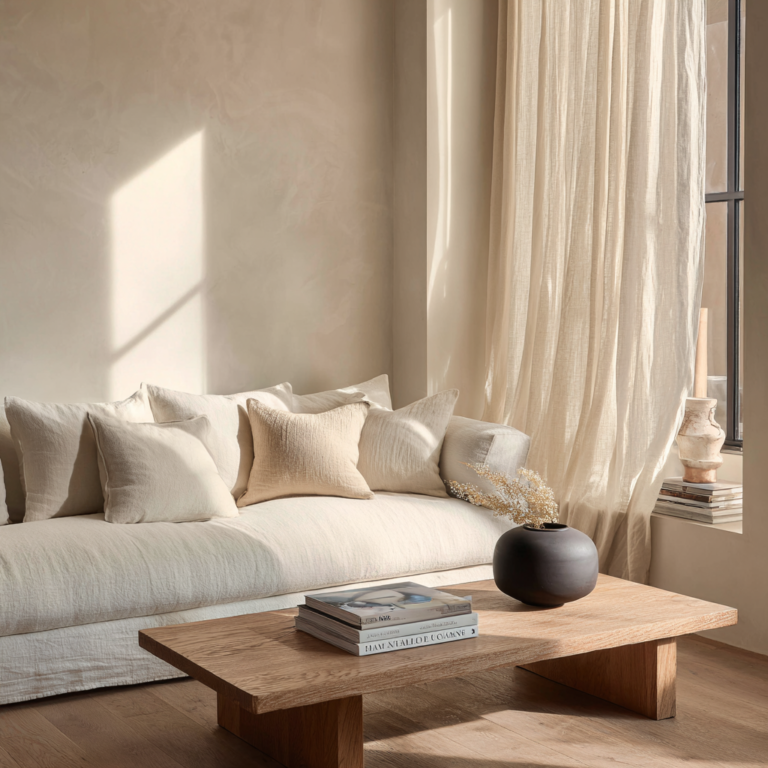
Sheer linen curtains are one of the warmest, simplest investments in a home. They filter direct light without blocking it, turning sharp midday sun into something diffuse and gentle. A room hung with linen sheers feels like being inside a paper lantern — glowing, soft-edged, full of warmth even on an overcast day.
And then there is the beauty of changing light — the way a room transforms hour by hour, season by season. Morning light arrives hesitantly and grows confident. Afternoon light slants lower and warmer. Evening light goes amber, then rose, then blue.
A warm minimalist home is one that notices these changes. That is designed to receive them. That doesn’t fight the movement of light across the day but celebrates it as one of the most beautiful, free, endlessly renewable things a home can offer.
Let the light move through your rooms. Let it land on your textured walls and wooden surfaces. Let it shift and soften as the hours pass.
It is doing something no lamp can fully replicate.

Creating Warm Artificial Light
When the sun goes down, the work of artificial light begins. And this is where most homes go quietly wrong.
The single most important choice you’ll make about artificial lighting is color temperature. This is measured in Kelvins — and the number matters enormously.
Bulbs in the 5000K–6500K range produce cool, blue-white light. These are the bulbs of offices, hospitals, and garages. They are efficient and functional and they will make your home feel like none of those things.
Bulbs in the 2700K–3000K range produce warm, amber-toned light — the color of candlelight, of incandescent glow, of the light that says evening is here and you are home. This is the range for warm minimalism. Full stop.
When replacing bulbs, look for “warm white” or “soft white” on the packaging and check that the Kelvin rating falls within that range. It is one of the smallest, cheapest, most transformative changes you can make in a home.
Dimmers are the next essential. The ability to lower your lights as the evening progresses — from functional brightness at dinner to a soft, low glow by nine o’clock — is one of the most underrated luxuries of home life. Install dimmers wherever you can. Use them.
As for fixtures, let warmth guide you. Floor lamps with fabric or paper shades diffuse light beautifully and anchor a corner of a room with soft presence. Table lamps create intimacy, especially when their shade is opaque enough to pool light downward rather than broadcast it in all directions. Wall sconces are extraordinary — they push light upward or sideways rather than downward, creating the kind of gentle, reflected glow that feels almost candlelit.
And speaking of candles: never underestimate them. A few candles lit in the evening — on a shelf, on a coffee table, in the bathroom — do something no electric bulb can replicate. The flame moves. It flickers. It is alive in a way that our nervous systems recognize and respond to with deep, instinctive calm.
What to avoid: the overhead ceiling light as your primary or only source. The bright, centrist, top-down light that creates harsh shadows beneath every nose and chin, that flattens texture and makes even beautiful rooms feel slightly like interrogation chambers.
Your ceiling light can exist. Let it be low on a dimmer, or replaced by a warmer pendant. But push the real work of evening illumination down to floor level, to table level, to the human scale where warmth naturally lives.
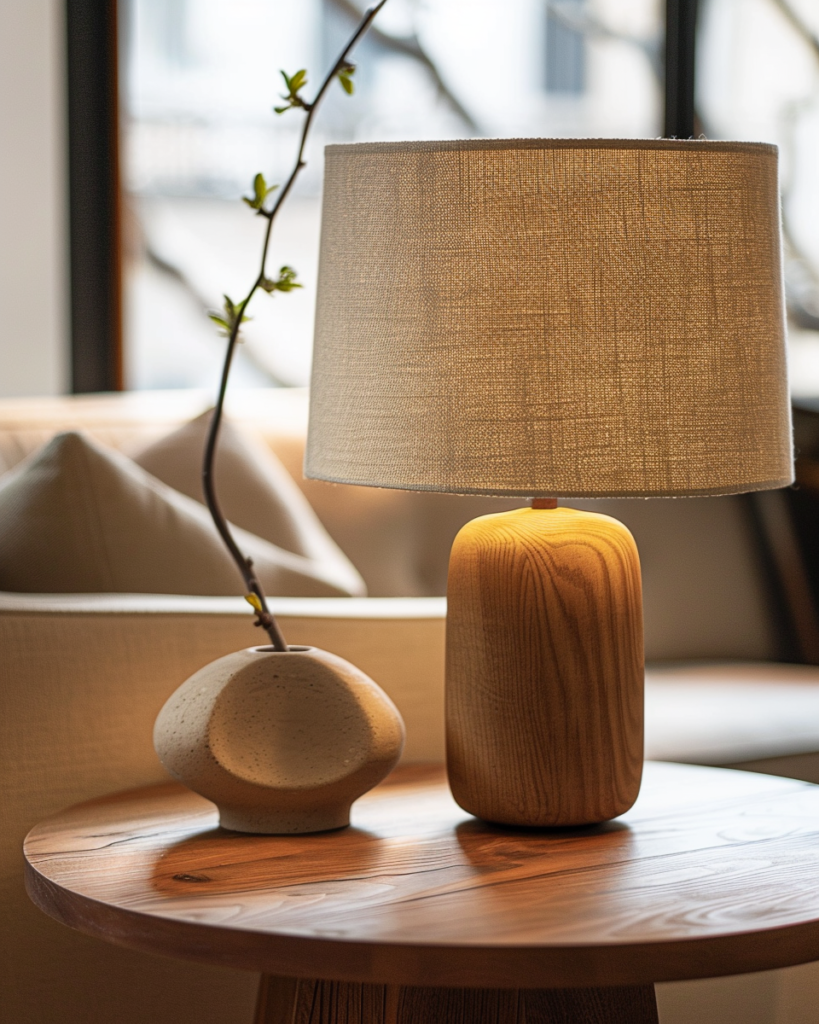
Common Lighting Mistakes and Gentle Fixes
Most lighting problems in a home come down to a few simple, very fixable habits.
One overhead light doing all the work. This is the most common issue, and the easiest to address. You don’t need to rewire anything. Simply add a floor lamp to the far corner of your room. Add a table lamp to a surface you use in the evenings. Let the overhead become supplemental rather than sovereign.
The wrong color temperature. If your bulbs are cool white or daylight spectrum, swap them for 2700K warm white. This single change — often costing less than ten dollars — can transform the entire emotional quality of a room.
Ignoring the time of day. Bright light in the morning feels energizing and right. That same bright light at nine in the evening feels jarring and exhausting. Build a habit of adjusting your lighting as the day shifts — dimming down after dinner, adding candles in the hour before bed.
Harsh shadows from directional light. If a lamp is creating stark shadows that feel unflattering or uncomfortable, try a shade with a softer, more diffuse material, or redirect the light source to bounce off a wall or ceiling rather than pointing directly into the room.
Every one of these fixes is gentle. None of them requires perfection. Think of each adjustment not as a correction but as a small act of care — for your home, and for yourself.
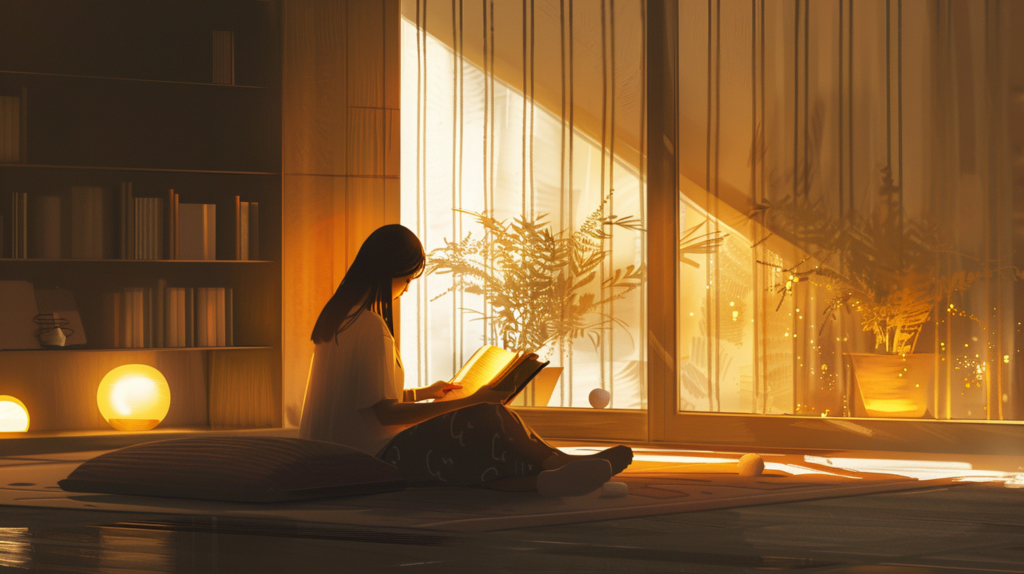
A Home Bathed in Warmth
We began this series talking about space — the way a room breathes when there is room to breathe. Then we talked about texture — the way simple surfaces come alive when they carry warmth and depth.
Now we arrive at light: the layer that makes all of it possible.
Without warm, intentional light, even the most beautifully curated space feels unfinished. But when the light is right — layered, warm, responsive to the time of day — something quietly miraculous happens. Space becomes sanctuary. Texture becomes story. Simplicity becomes soulful.
This week, try just one thing. Swap one cool-white bulb for a warm one. Add a small lamp to a corner that’s been dark. Light a candle at dinner. Dim your lights an hour earlier than usual and notice how the room — and you — respond.
You don’t need to overhaul anything. Light teaches us that transformation can be incremental, quiet, and profound.
Let your home be bathed in warmth. Let the light hold everything.
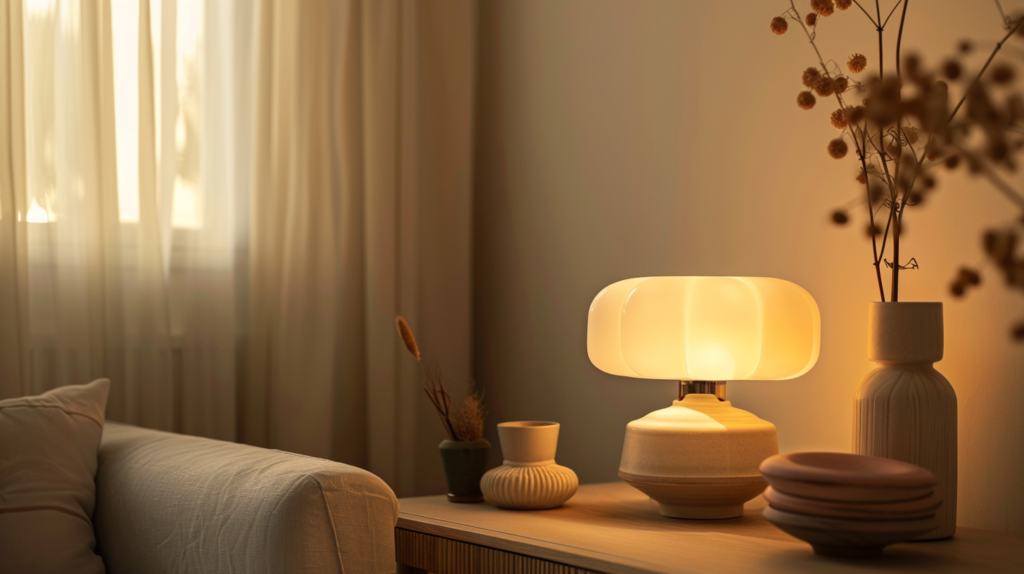
If this piece resonated with you, I’d love to invite you to try one small lighting shift this week — just one warm bulb, one extra lamp, one candle at dusk. Share what you notice. Sometimes the smallest changes open up the most light.
Join the Circle of Warmth
A quiet letter on warm, intentional living — delivered occasionally.